Three Quick Fixes to Rescue Multi Touch Attribution in 60–90 Days

Multi-touch attribution assigns fractional credit to every touchpoint in a customer’s path to conversion, not just the last click. It’s a tactical tool: use it to optimize channel mix, campaign spend, and creative performance when you have solid first-party data and enough conversion volume to make the math meaningful. If your sales cycle is short, your conversion count is low, or your identity data is thin, MTA will mislead you more than it helps.
Table of Contents
What Is Multi-Touch Attribution and Why It Matters for Budget Decisions
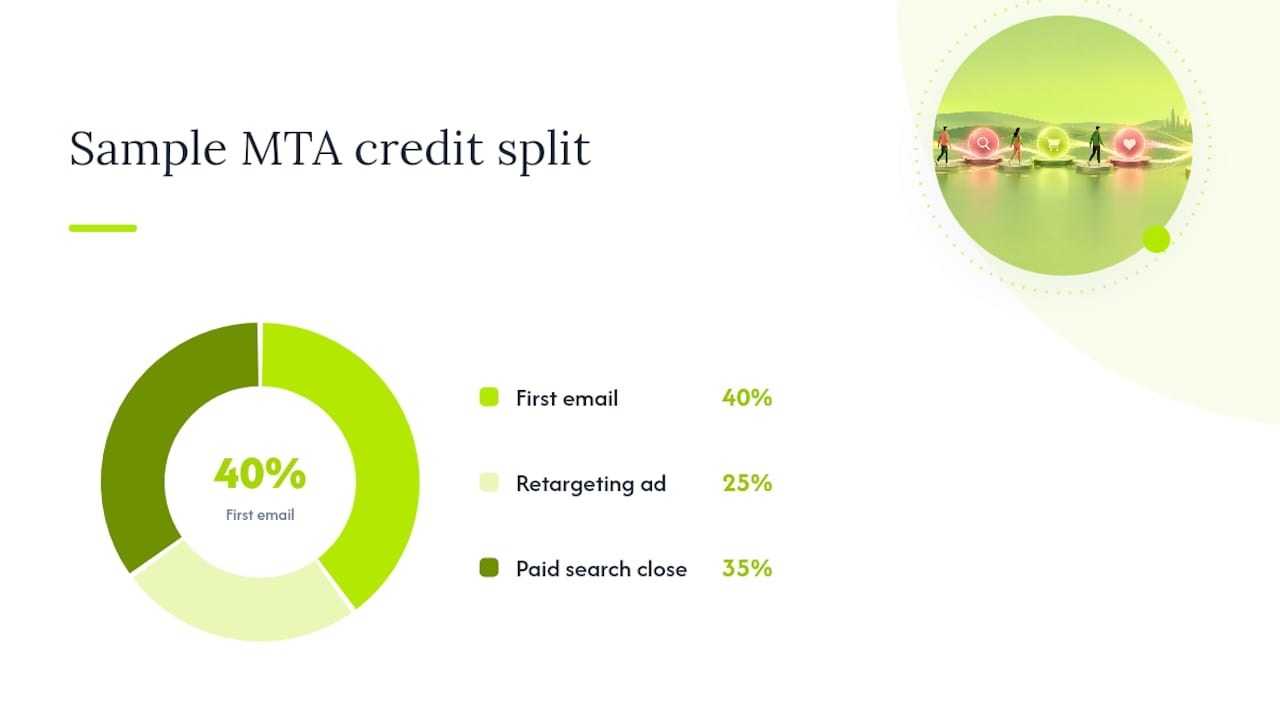
Multi-touch attribution splits credit for a conversion across every touchpoint a customer hits before they buy. Instead of handing 100% of the credit to the last ad clicked, an MTA model might assign 40% to the first email, 25% to a retargeting ad, and the rest to a paid search click that closed the deal. That fractional approach corrects a distortion that’s plagued digital marketing for years.
Last-click attribution, still the default in Google Analytics and plenty of ad platforms, rewards whichever channel happened to close the sale. It systematically undervalues top-of-funnel channels like display, social, and content, which do the work of building awareness but rarely get the final click. Nielsen’s research on attribution methods points out that MTA’s real strength is granularity: it lets you see near-real-time performance at the campaign, audience, and creative level, something single-touch models simply can’t show.
The business case for switching comes down to a few concrete wins:
None of this makes MTA a strategic budget-planning tool. It answers “which campaign should I tweak this week,” not “how much should I spend on TV next quarter.” Keep that distinction in mind before you build a model.
Which MTA Model Should You Use?
Model choice depends on your funnel length, your conversion volume, and how much engineering effort you’re willing to put in. Here’s how the main options break down:
A subscription business with a 90-day sales cycle and heavy mid-funnel nurturing tends to land on W-shaped. A high-volume e-commerce brand running thousands of transactions a month has the data to justify going data-driven from the start. Everyone else usually starts rule-based and graduates later, which is the sequencing Fairview’s implementation guide recommends for good reason: you can’t validate a complex model against data infrastructure that isn’t ready yet.
What Data and Infrastructure Does MTA Require?
MTA lives or dies on identity resolution. If you can’t reliably tie a touchpoint on Monday to a conversion on Thursday, the model has nothing real to work with. The IAB’s attribution primer breaks the requirement into three data categories: user attributes, media touchpoints, and conversion or sales data, all stitched together under a single “platform of record” so numbers don’t drift between tools.
In practice, that means building out:
Pro Tip: *Before you touch a model, run a contact-stitching audit. Pull 100 recent conversions and check what percentage have a complete touchpoint history back to first contact.
On volume, implementation guidance generally points to a minimum of 90 to 180 days of clean historical touchpoint data before a model output means anything, and data-driven approaches specifically need the 1,000-plus monthly conversions mentioned earlier. Teams below that threshold aren’t stuck: rule-based models (linear, time-decay, position-based) work fine on thinner data, they just require more human judgment about which weighting scheme fits the business.
How to Implement Multi-Touch Attribution Step by Step
Building MTA is less about picking a fancy model and more about getting the plumbing right first. Here’s the sequence that actually holds up.
The parallel-run period matters more than teams expect. It’s the window where you catch a stitching bug, a UTM typo repeated across fifty campaigns, or a channel that looks great in MTA but collapses in a holdout test. Skip it, and you’ll be reallocating budget based on a number nobody has stress-tested.
What Breaks MTA in a Cookieless World
Third-party cookie deprecation and Apple’s App Tracking Transparency framework have made individual-level tracking, the thing MTA fundamentally depends on, increasingly unreliable. When you can’t see a user consistently across sessions and devices, the model fills gaps with probabilistic guesses, and those guesses tend to break in a specific direction.
Analyses in 2026 found that MTA models over-credit digital channels by more than 30% in many large ad accounts, largely because digital touchpoints are easier to track than offline or delayed-conversion channels. A TV ad that drove someone to search your brand two weeks later gets no credit in most MTA setups, while the paid search click that followed it gets full marks. That’s not a minor rounding error. It’s a structural bias that pushes budget toward channels that are simply easier to measure, not necessarily the ones doing the most work.
A few mitigations preserve useful signal without pretending the identity problem is solved:
How Do You Combine MTA, MMM, and Incrementality Testing?
None of the three major measurement approaches works well alone anymore. MTA answers “which touchpoint influenced this specific conversion,” MMM answers “how much did this channel contribute to revenue over the past quarter,” and incrementality testing answers “would this conversion have happened without the ad at all.” Different questions, different time horizons, and increasingly, most serious marketing teams run all three at once.
Adoption data backs that shift: MTA usage climbed to 47% of marketing teams in 2026, while MMM adoption rose to 26%, nearly triple its 2023 level. That’s not one method replacing the other. It’s teams running both in parallel because each covers the other’s blind spot.
The operating model that privacy-first measurement frameworks recommend for 2026 splits responsibilities cleanly:
When MTA and MMM disagree on a channel’s contribution by more than roughly 20 to 30%, treat that gap as a trigger for a targeted incrementality test rather than an immediate budget swing. Label every number by its source when you present to finance. “MTA says X, MMM says Y, here’s what the holdout test showed” builds far more credibility than presenting a single number as gospel.
What Metrics Should You Track for Ongoing MTA Health?
A handful of numbers, checked on a regular cadence, keep an MTA system honest. Report attributed revenue by channel and touchpoint position, assisted conversions (not just last-touch conversions), common touchpoint sequences leading to close, and how sensitive your results are to attribution window length.
Keep monitoring your contact-stitching rate regularly rather than only auditing it once. A dashboard that puts MTA output next to last-touch numbers and MMM’s channel envelopes side by side, with recent experiment results annotated, gives stakeholders the full picture instead of a single misleading number.
Run these checks quarterly: audit UTM tagging across every live campaign for naming drift, recheck your stitching rate against the original baseline, and confirm every conversion event still fires and logs correctly in the CRM.
What Are the Legal and Ethical Limits on MTA Data Usage?
MTA depends on collecting and linking behavioral data across sessions, devices, and often offline touchpoints, which puts it squarely inside data protection frameworks like the GDPR in the European Union and various state-level privacy laws in the United States. Consent requirements vary by jurisdiction, but the general principle holds everywhere: if you’re tracking a specific individual’s journey across channels, you generally need a lawful basis to do it, and that basis has to be documented and auditable.
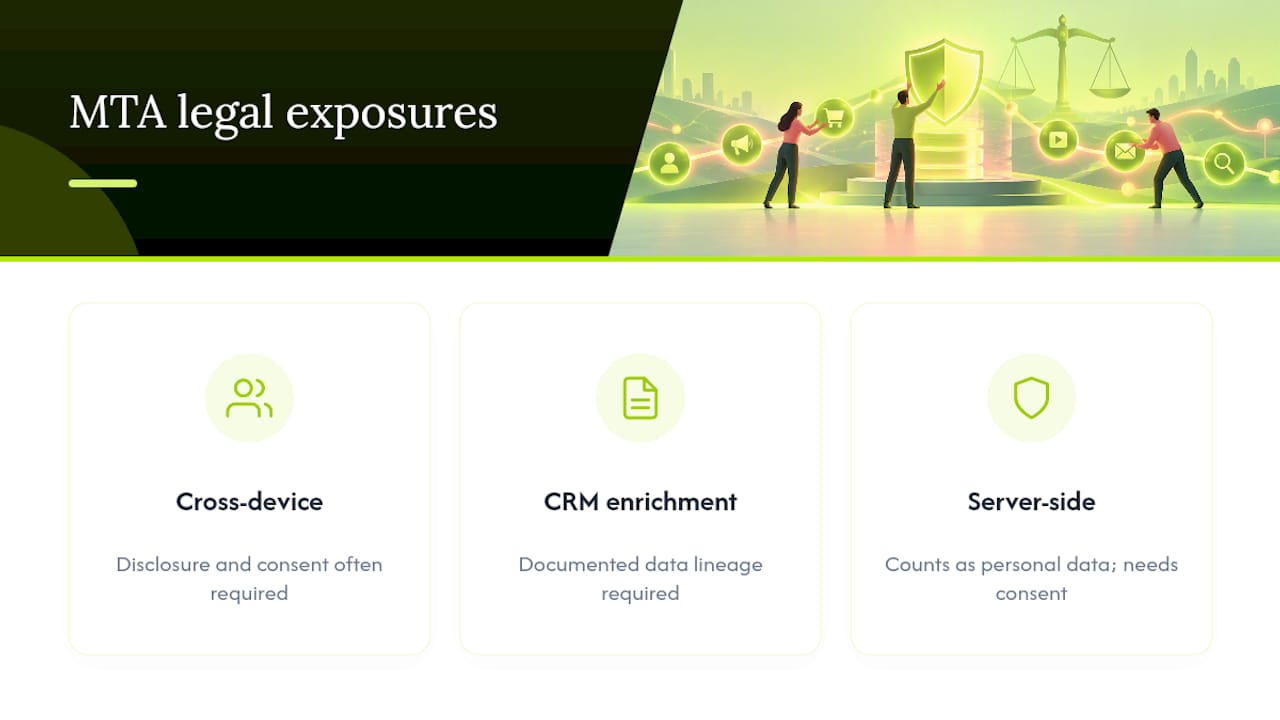
The practical exposure shows up in three places. First, cross device tracking that links a phone and a desktop to the same person requires clear disclosure in your privacy policy, and in many jurisdictions, active consent before that stitching happens. Second, CRM data enriched with third-party sources needs a documented lineage, since regulators increasingly ask companies to show exactly where behavioral data originated. Third, server side tracking cookies and Conversions API implementations still process personal data even though they bypass the browser, which means they fall under the same consent obligations as client-side tracking, not an exemption from them.
Ethically, the bigger issue is proportionality. Just because you can stitch a user’s identity across five devices and eleven touchpoints doesn’t mean every business objective justifies that level of tracking. Teams that build MTA responsibly tend to collect the minimum data needed to answer the attribution question at hand, set retention limits on raw touchpoint data, and give users a genuine, findable way to opt out of cross-channel tracking. None of that is optional compliance theater. It’s what keeps an attribution program defensible when a regulator or a journalist starts asking questions.
How Does MTA Connect With Marketing Automation Tools?
MTA output is only useful if it reaches the systems where marketers actually make decisions, which means integration with your marketing automation platform and ad optimization tools matters as much as the model itself. A model producing beautiful fractional-credit numbers that live in an isolated dashboard nobody checks is not an operational attribution system, it’s a report.
The practical integration points run through a few systems. Marketing automation platforms (HubSpot, Marketo, Salesforce Marketing Cloud) need touchpoint and attribution data flowing back into contact records so sales and marketing see the same influence history on a lead. Ad platforms benefit from attribution signal flowing the other direction, feeding into bid optimization so budget shifts toward the touchpoints your model says are actually working, rather than waiting for a quarterly manual review. Business intelligence layers (Looker, Tableau, or a CRM-native reporting suite) need to host the attribution model’s output alongside last-touch numbers and MMM envelopes, so nobody’s making a decision off a single, unlabeled figure.
The connective tissue across all of this is the platform-of-record approach the IAB recommends: one system where user attributes, media touchpoints, and conversion data all reconcile, feeding every downstream tool from the same source. Without that, you end up with three tools showing three different attribution numbers for the same campaign, and nobody trusts any of them.
Where Is MTA Headed Next?
Machine learning is doing more of the heavy lifting inside data-driven attribution models, moving beyond fixed weighting rules toward models that continuously reweight touchpoints based on observed conversion patterns. That’s a meaningful upgrade for teams with the volume to support it, but it doesn’t solve the identity problem. A better algorithm still needs real signal to work with, and that signal is getting harder to collect at the individual level.
That’s why the clearest trend for 2026 isn’t a smarter model, it’s a shift toward privacy-first architecture underneath the model. Server-side tracking, first-party data collection, and modeled conversion signal (where machine learning fills gaps left by lost identifiers using aggregate patterns rather than individual tracking) are becoming the default rather than the exception. Expect probabilistic identity resolution, matching users across devices based on statistical patterns rather than a persistent ID, to keep expanding as deterministic matching gets harder under evolving consent rules.
The direction of travel favors teams that invest in first-party data relationships now. A brand with a strong logged-in experience, a robust CRM, and disciplined server-side event tracking will have far more usable signal for its models in two years than one still leaning on third-party cookies and browser-based pixels. The model architecture will keep improving. The businesses that win are the ones building the data foundation those models need to run on.
What Should Analytics Teams Actually Do First?
Fix your data plumbing before you touch a model. A perfectly designed W-shaped attribution scheme running on broken contact-stitching produces confident, precise, completely wrong numbers, and that’s worse than no model at all.
Run whatever model you land on in parallel with last-click for 60 to 90 days, and don’t move serious budget until an experiment confirms what the model’s telling you. If you do nothing else this quarter, run a UTM audit, measure your contact-stitching rate, and launch one geo holdout test. Those three moves, cheap and fast, will teach you more than any model swap.
Sources
For technical depth beyond this guide, read the IAB Multi-Touch Attribution Primer on data requirements, Nielsen’s methods and models guide, and Search Engine Land’s comparison of MTA and MMM for framework selection.
FAQ
What Does Multi-Touch Attribution Mean?
Multi-touch attribution is a measurement method that assigns fractional credit for a conversion across every touchpoint a customer interacted with, rather than crediting a single channel. Models differ in how they distribute that credit, whether evenly (linear), weighted toward recent touches (time-decay), or calculated statistically from conversion patterns (data-driven).
What Is the Difference Between Single-Touch and Multi-Touch Attribution?
Single-touch attribution, like last-click or first-click models, gives 100% of conversion credit to one touchpoint and ignores everything else in the journey. Multi-touch attribution splits that credit across multiple touchpoints, which gives a more complete picture of which channels actually influence a sale, especially for longer or more complex buying journeys.
How Do You Build a Multi-Touch Attribution Model?
Start by auditing your contact-stitching rate and fixing any identity or UTM tracking gaps, since a model is only as reliable as the data feeding it. From there, implementation guidance recommends starting with a rule-based model like position-based attribution, running it in parallel with last-click for 60 to 90 days, then moving to data-driven attribution once you have roughly 1,000 or more monthly conversions and clean historical data.
What Is the Difference Between MTA and MMM?
Multi-touch attribution operates at the individual touchpoint level and answers tactical questions, like which campaign or creative to adjust this week. Marketing mix modeling works at an aggregate level using statistical regression on spend and revenue data, answering strategic questions about overall budget allocation across channels, including offline ones MTA can’t track. Most measurement frameworks in 2026 recommend running both together, with incrementality testing to validate results from each.
Created with BabyLoveGrowth to create better content